Loading...
Bellingham Concrete builds stamped concrete patios, driveways, garage floors, and foundations for homeowners throughout Arlington and the Smokey Point area. We know the flat Stillaguamish River valley floor drainage conditions that challenge concrete work here, the wet winters that test sealed surfaces, and the freeze-thaw cycles that crack older flatwork season after season. We reply within one business day and pull all permits.
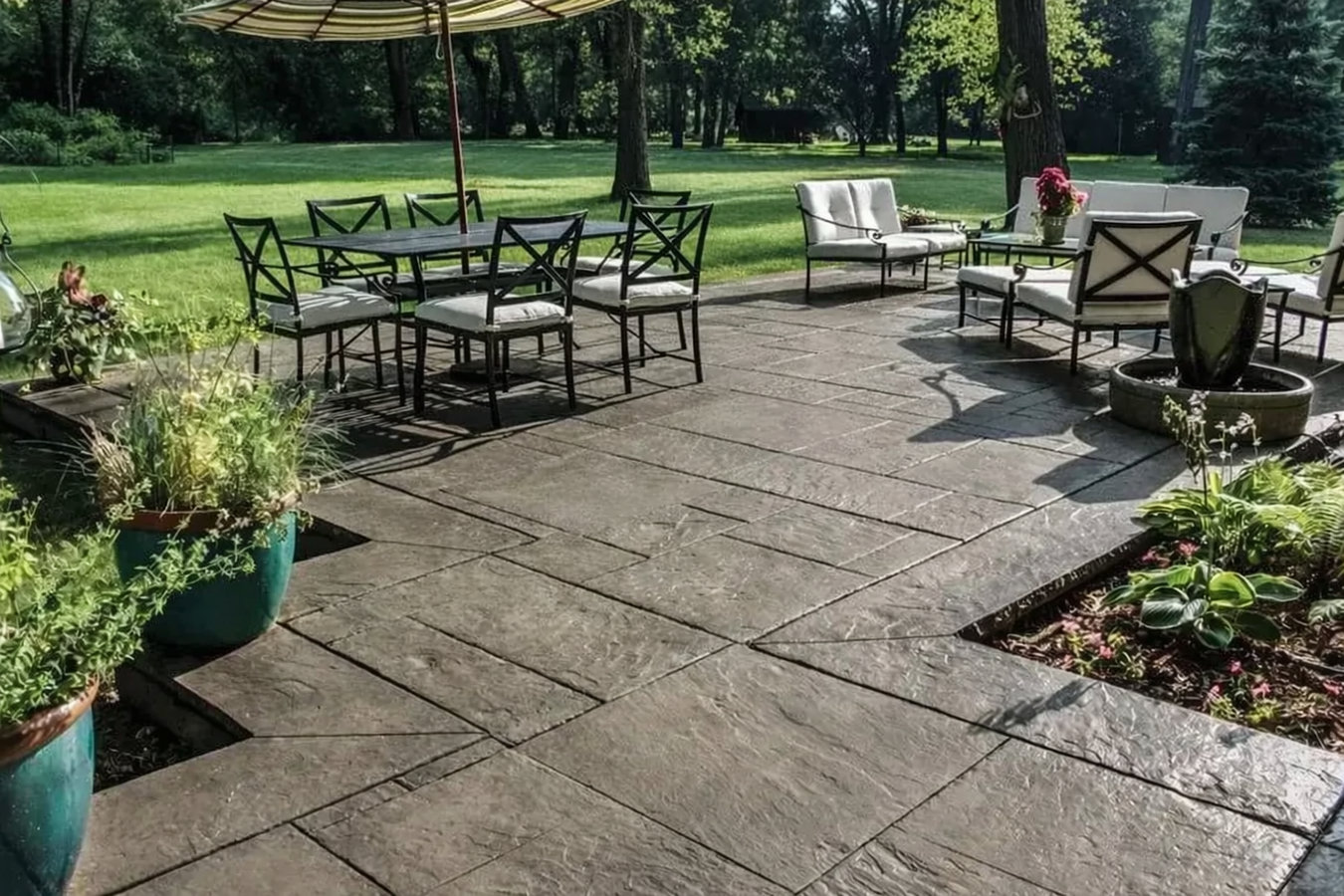
Arlington homeowners who want a patio, walkway, or front entry that looks like natural stone or brick - without the weed-filled joints and shifting pieces that come with pavers - are choosing stamped concrete more often as the standard single-family lot here gives them real outdoor space to work with. The challenge in Arlington is that the flat Stillaguamish River valley floor does not drain quickly on its own, so stamped concrete here has to be designed and sloped from the start so water moves away from the house rather than pooling against it. A properly graded, correctly sealed stamped surface handles the 45-inch Arlington wet season without cracking or growing moss. See the full stamped concrete process on our stamped concrete services page.
A large share of Arlington homes were built between the 1970s and 1990s, which puts original concrete driveways in many of those neighborhoods at 30 to 50 years old - well past the point where Snohomish County freeze-thaw cycles have worked through the surface. The newer subdivisions near Smokey Point have driveways poured in the 2000s and 2010s that are now approaching the 15-to-20-year mark, where first cracks typically appear. Arlington driveways built on properly compacted gravel with a drainage slope that accounts for the flat valley floor last significantly longer than those where drainage was an afterthought.
Arlington summers - from late June through September - are the outdoor living window here, and a well-built backyard patio with the right drainage slope gives families a surface that stays dry and usable through that season. Properties on the flat valley floor have yards that stay wet deep into spring; a patio without a built-in drainage plan will hold water against the foundation wall rather than directing it away. Getting the slope right at the time of pour is far less expensive than correcting drainage problems after the fact.
Single-family homes throughout Arlington - from the older blocks near downtown along Olympic Avenue to the newer two-story homes near Smokey Point - almost all have attached or detached garages. Garage slabs in older Arlington homes were often poured without vapor barriers, and the flat valley floor moisture environment means those original slabs have been dealing with ground moisture from below for decades. Replacement floors poured on a proper gravel base with a vapor barrier handle that moisture load correctly and give homeowners a clean, stable surface for the garage's next phase of life.
Properties east of downtown Arlington along the Highway 530 corridor often sit on larger lots with grade changes from the foothills rising toward the Cascades. Concrete retaining walls on those properties hold back soil that would otherwise erode or slide during the 45-plus inches of annual rain Arlington receives. Well-built retaining walls in this environment need drainage built into the wall itself - weep holes and gravel backfill - so water pressure does not build up behind the wall face during the wet season.
Arlington sits in the Stillaguamish River valley and receives around 45 to 50 inches of rain per year - among the higher totals in western Washington. The city's position on the flat valley floor is the key detail: flat land does not drain quickly on its own, and soil in the valley holds water rather than moving it away. After a heavy Pacific Northwest rain, yards and the ground under driveways can stay saturated for days. That persistent moisture pushes up from below against slabs and works sideways against foundations. On top of that, Arlington sees regular freeze-thaw cycles from November through March - cold nights where temperatures drop below freezing, then warmer days that thaw whatever froze the night before. Water in small concrete cracks freezes and expands with each cycle, turning hairline cracks into wider gaps every winter.
Arlington's housing stock adds another layer of consideration. Most homes were built between 1970 and 2000, and a significant number of those original concrete driveways and garage slabs have never been sealed or properly maintained. At 30 to 50 years old in this climate, those slabs have been through hundreds of freeze-thaw cycles. The newer subdivisions near Smokey Point to the north have homes from the 2000s and 2010s whose concrete flatwork is just beginning to show first-generation wear. East of town along the Highway 530 corridor, older rural homes on larger lots sometimes have gravel driveways that wash out and become unusable from October through April - concrete is the lasting answer for those properties, and the drainage design has to account for the foothills topography rather than flat suburban geometry.
We pull permits through the City of Arlington Building Department for work inside the city limits, and properties in unincorporated Snohomish County outside the city go through county permitting. The two processes have different timelines and review requirements, and knowing which one applies to your address up front keeps the project on schedule. Many Arlington homeowners are commuters who are away from their properties during the day - we are set up to work without the homeowner on-site and communicate clearly at the start and end of each day.
The Smokey Point area north of Arlington on I-5 has seen steady residential growth and has a very different working environment from the older blocks along Olympic Avenue in downtown Arlington or the rural properties heading east on Highway 530 toward Darrington. Near the Arlington Municipal Airport on the west side of town, lots are open and access is straightforward. Along the Stillaguamish River corridor, we account for the drainage conditions specific to that low-lying ground. We also serve Bellingham to the north, where we operate out of our main location, and Everett to the south - both give us a broad familiarity with the Snohomish County corridor that Arlington sits within.
Call or use the contact form and tell us what you are looking at - a stamped patio, a driveway, a garage floor, or something else. We reply within one business day. For stamped concrete projects, it helps to have a rough idea of the area size and any pattern or color preferences, though we can work through those options together during the site visit.
We come to your property and measure the area, assess the existing surface or soil conditions, and look at how water currently moves across your property. Arlington's flat valley floor terrain means drainage planning is a key part of every flatwork estimate here - not an afterthought. This is also where we talk through realistic cost and whether permits are required for your specific project and address.
Once you approve the written estimate, we handle the permit application - whether that goes through the City of Arlington or Snohomish County, depending on your address. We manage the paperwork and timeline and let you know as soon as a pour date can be confirmed. You do not need to make any city hall calls.
We remove any existing concrete or vegetation, prep and compact the base, set forms, and pour - including the stamping or finish work for decorative projects. Before we leave, we walk you through the surface, show you the control joints, tell you exactly when you can walk and drive on it, and explain how to maintain the sealer. For stamped concrete, resealing every two to three years keeps the color protected and the surface safe to walk on in wet Arlington winters.
We serve homeowners throughout Arlington, from downtown along Olympic Avenue to Smokey Point and the Highway 530 corridor. Written estimates, one business day reply, and permits handled start to finish.
(360) 299-5624Arlington is a city of about 22,000 people in Snohomish County, sitting in the Stillaguamish River valley with farmland to the west and forested foothills rising toward the Cascades to the east. Around 60% of homes are owner-occupied, and the city has grown steadily over the past two decades as residents moved north from the Everett-Seattle corridor looking for more space. The historic downtown along Olympic Avenue has an active small-city character with local shops and restaurants, while the Smokey Point area to the north has seen heavy commercial and newer residential development in recent years. Highway 530 runs east from Arlington through rural stretches toward Darrington, and properties along that corridor are older and sit on larger lots - a fundamentally different environment from the newer subdivisions at the north end of town.
The housing stock here covers a wide range: modest single-family homes from the 1970s and 1980s near downtown, tract homes from the 2000s near Smokey Point, and older rural properties along Highway 530 where gravel driveways and outbuildings are common. Many Arlington residents commute south to jobs in Everett or Marysville, which means they rely on contractors who can work reliably without the homeowner on-site. We also regularly work in Everett to the south, where a different urban environment brings its own concrete challenges, and in Marysville between the two - giving us a continuous working knowledge of the Snohomish County I-5 corridor.
Durable concrete driveways designed and poured for lasting curb appeal.
Learn moreCustom concrete patios built to extend your outdoor living space.
Learn moreDecorative stamped concrete mimicking stone, brick, or tile patterns.
Learn moreSafe, ADA-compliant concrete sidewalks for residential and commercial sites.
Learn moreSmooth, sealed concrete garage floors built to handle heavy use.
Learn moreStained and textured finishes that transform plain concrete into a design feature.
Learn moreStructural retaining walls that manage grade changes and prevent erosion.
Learn moreInterior and exterior concrete floors installed level and finished to spec.
Learn moreSlip-resistant, attractive pool decks poured to complement your backyard.
Learn moreSolid concrete steps and stoops built for safety and long-term durability.
Learn moreEngineered slab foundations poured correctly the first time.
Learn moreFull foundation installation services for new residential and commercial builds.
Learn moreCommercial concrete parking lots designed for high traffic and longevity.
Learn morePrecisely poured footings providing a stable base for any structure.
Learn moreFoundation leveling and raising to correct settlement and restore structural integrity.
Learn morePrecision concrete cutting for expansion joints, repairs, and modifications.
Learn moreFrom stamped patios in the Smokey Point subdivisions to driveway replacements along the Highway 530 corridor, we know Arlington's valley floor drainage conditions and what concrete work here needs to last. Call or fill out the form and hear back within one business day.